
I was recently reading a book where the author described a particular church that he had interacted with in the past. The church was in the middle of a construction project (they were building a new auditorium) and this was the writer’s description of the situation:
“When asked how the church was doing, members usually told how the building program was going and often expressed impatience with the process. They honestly believed the church could not move ahead until the new building was finished. The building program, rather than motivating members to reach out, tended to put the church’s ministries on hold.”
This story was not hard for me to imagine. I could easily picture a congregation who had gotten distracted from their mission because of some task that was supposed to be a step along the way (a step meant to help them accomplish their primary mission) had now replaced the primary mission.
A similar thing happened to me years ago at a different church – only the issue didn’t revolve around a building project.
I was helping out at a church that was in between pastors. And while I was the person who preached most Sundays, I was not the official installed pastor at the church. However, since no one else was either, there were some leadership decisions that I felt compelled to make in the interim. And one of those decisions was to get rid of the financial box on the back of each bulletin.
If you are unfamiliar with this practice (Good News hasn’t used a bulletin in about a decade) here’s how it generally works. As you walk into the auditorium on Sunday, a friendly greeter hands you a little booklet similar to a playbill or an event program. The name of the church is on the cover, the order of the worship service is in the middle, and on the back many times they would have a little box that looked like this:
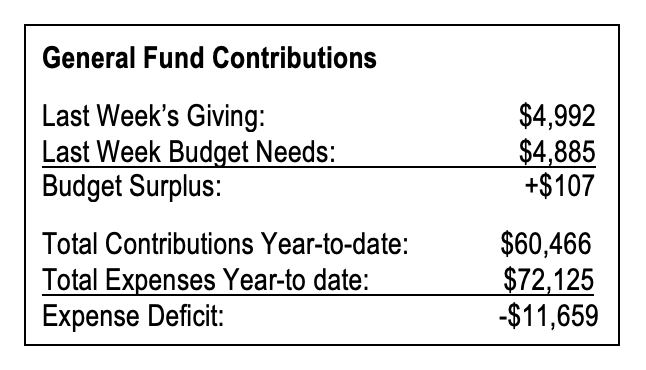
Now I want to be clear that I don’t believe it’s always wrong for a church to put this kind of information in the bulletin. However, in the case of this particular church, I remember thinking that the congregation was overly focused on church finances. Shortly after I began preaching there, I said to the church secretary, “We have to get that box off the back of the bulletins. The church members are treating it like a scoreboard!”
Now I want to be clear that I don’t believe it’s always wrong for a church to put this kind of information in the bulletin. However, in the case of this particular church, I remember thinking that the congregation was overly focused on church finances. Shortly after I began preaching there, I said to the church secretary, “We have to get that box off the back of the bulletins. The church members are treating it like a scoreboard!”
It seemed to me that the major concerns of that congregation were not reaching unbelieving people with the gospel, discipling believers so that they grow in their faith, or other similar things. It appeared to me that they believed that when contributions were up that meant we were “winning,” and when giving was down, that meant we were “losing.”
It was as if the maintaining of the nonprofit organization (which was originally a tool started to help the congregation complete its mission) had become the church’s mission.
I think that happens a lot. However, the truth is that the nonprofit organization is only as good as it is at helping the people of the church complete the mission God has for them. Jesus didn’t say “go into all the world and start non-profits.” He said, “Go into all the world and make disciples.” It’s not that non-profits are bad. It’s just that their maintenance isn’t the mission of the church. Rather, their existence is a tool of the church. And, of course, tools need to be maintained, but they aren’t supposed to eclipse, in importance, the big group project that they were designed for.
So, I guess one of the briefest ways I could answer the question, “Why doesn’t Good News Church talk about the church budget on Sunday mornings more often?” would be this: “Because balancing the budget isn’t the mission of the church.” Of course, we need a few bookkeepers/administrators to make sure we don’t go off course. And, yes, we need people who will donate to the cause so that we can continue to worship indoors, pay staff, run programs, etc. However, the majority of the congregation doesn’t need to be thinking about the church budget every single week. The majority of the church needs to be thinking about “loving God, loving each other, and loving people who don’t know God yet” every single week.
If we do that, we’ve won, even if the non-profit struggles or shuts down. And if we don’t do that, we’ve lost, even if the non-profit is well-funded.